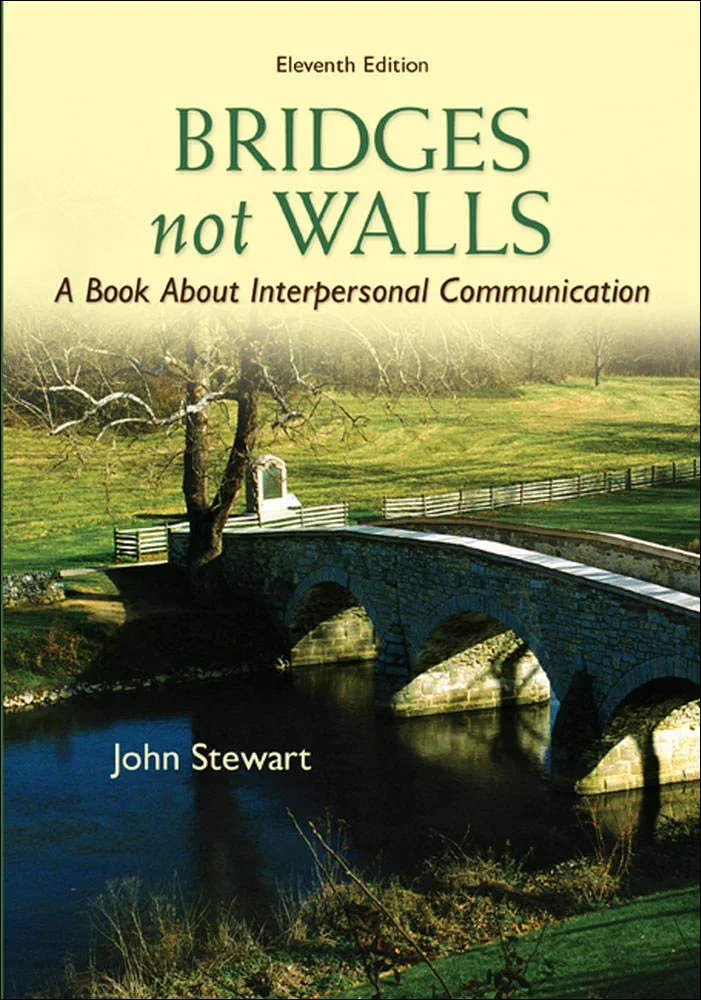
Bridges Not Walls
Interpersonal Communication · Anthology (11th ed.) · 2012
Out of print
Edited by John Stewart Published by McGraw-Hill Publishing Co., 2012 ISBN 978-0-07-353431-2
Overview
Forty-five readings by forty-eight different authors are collected here in twelve chapters that address Foundations of Interpersonal Communication, Making Meaning Together, Relationships, and Bridges Not Walls. All the selections are written by experts who write simply and clearly, and ten are authored or co-authored by the editor, John Stewart. The book covers all the important sub-parts of interpersonal communication without being a dry “survey of the literature.” Everything I wrote is offered in an accessible, conversational tone, and I look for the same quality in the other people’s materials that I include. You can learn how communication and interpersonal communication are related; how identities are co-constructed; the ins and outs of verbal and nonverbal codes; perceiving and listening; expressing and disclosing; communicating with family and friends; communicating with intimate partners; coping with communication problems like deception, defensiveness, power, and verbal aggression; conflict management; bridging cultural differences; and promoting dialogue. A bulleted list of “Main Ideas” begins each reading, so you know what to look for. Review questions and Probes also accompany each reading, so you can check to see if you tracked what the writer said (Review questions) and how well you can extend the ideas to everyday applications (Probes). In addition, there are extensive reference lists for those who want to do further research on any of the topics.Content and Topics
The book defines communication as the continuous, collaborative process of verbal and nonverbal meaning making. You learn how no one person completely controls a communication event and that no single person can be blamed for a communication outcome. You learn about how choice, culture, and identities figure in all communicating, and how the most ordinary communication events, conversations, are the most influential. You also learn the key skill of “nexting,” which helps you deal with communication difficulties. Here are some of the main points that the readings make:- One way communication affects quality of life is that your personal relationships affect your physical health.
- Social media can promote or destroy interpersonal contact, depending on how they’re used.
- Identities are constructed in the ways people listen to and talk with each other.
- “And” and “next” are two of the most important words in the English language, and there are eight words and phrases to avoid in LGBT (Lesbian, Gay, Bisexual, Transgender) communication.
- Nonverbal communication functions in five main ways.
- The most effective listening is mindful, empathic, and dialogic.
- You can build relationships by carefully being open with and to other people.
- It’s crucial to separate messages from metamessages in family talk.
- There are several specific ways to communicate intimacy, affection, and social support.
- You can learn how to cope with hurtful messages and how to reduce defensiveness.
- There are ways to handle the break-up of relationships gracefully and with minimal hurt.
- Individualistic cultures are different from collectivist cultures in many significant ways.
- There are several specific ways to build relationships with people culturally different from you.
- Dialogue can help turn enemies into friends.
Background
Bridges Not Walls is designed for basic and mid-level studies of interpersonal communication. Since the first edition was published in 1973, it’s been used in first-year and sophomore communication classes at colleges and universities across the country. It’s also been used in social and clinical psychology, sociology, educational psychology, and counseling classes and with adult learners in seminars and workshops. Topic coverage is broad enough to support most courses, and the anthology design makes it easy to change the order of the ideas and omit chapters or readings that don’t apply. The readings are research-supported and the emphasis is on accessibility and usefulness rather than on social scientific rigor. The goal is to help with understanding and practical application, not to “cover the literature.” Research rigor may be important for graduate studies, but Bridges is written more for the layperson audience.Table of Contents
Part One: Foundations of Interpersonal Communication Chapter 1 Introduction to the Editor and To This Book Chapter 2 Communication and Interpersonal Communication John Stewart: Communicating and Interpersonal Communicating Malcolm Parks: Personal Relationships and Health Susan Scott: Fierce Conversations Abdul K. Sinno, Rafic Sinno, & John Stewart: Social Media, Where Interpersonal Communication Meets Mass Communication Chapter 3 Communication Building Identities John Stewart, Karen E. Zediker, and Saskia Witteborn: Constructing Identities Steve Duck and David T. McMahan: Self and Identity: Transacting a Self in Interaction with Others Douglas Stone, Bruce Patton, & Sheila Heen, Identity and Difficult Conversations Chapter 4 Verbal and Nonverbal Contact John Stewart and Carole Logan: Verbal and Nonverbal Dimensions of Talk Steve Duck and David T. McMahan: Talk and Interpersonal Relationships John Stewart: Two of the Most Important Words Ben Finzel: Say What? Eight Words and Phrases to Avoid in LGBT Communication Steve Duck and David T. McMahan: What are the Functions of Nonverbal Communication? Part Two: Making Meaning Together Chapter 5 Inhaling: Perceiving and Listening John Stewart, Karen E. Zediker, and Saskia Witteborn: Inhaling: Perception Julia T. Wood: Its Only Skin Deep: Stereotyping and Totalizing Others Rebecca Z. Shafir: Mindful Listening John Stewart, Karen E. Zediker, and Saskia Witteborn: Empathic and Dialogic Listening Chapter 6 Exhaling: Expressing and Disclosing David W. Johnson: Being Open with and to Other People Douglas Stone, Bruce Patton & Sheila Heen, Expression: Speak For Yourself With Clarity and Power Part Three: Relationships Chapter 7 Communicating with Family and Friends Julia T. Wood: What’s a Family, Anyway? Deborah Tannen: Separating Messages from Metamessages in Family Talk Steve Duck: Our Friends, Ourselves William Paul Young: Relationships and Power Chapter 8 Communicating with Intimate Partners Laura K. Guerrero, Peter A. Andersen, & Walid A. Afifi, Communicating Closeness:`: Intimacy, Affection, and Social Support Malcolm R. Parks: Gender and Ethnic Similarities and Differences in Relational Development Lawrence A. Kurdek, What Do We Know About Gay and Lesbian Couples? Erik Qualman: Word of Mouth Goes World of Mouth: Relationships and Social Media Part Four: Bridges Not Walls Chapter 9 Coping With Communication Walls John Stewart, Karen E. Zediker, and Saskia Witteborn: Deception, Betrayal, and Aggression Anita L. Vangelisti: Messages that Hurt Jack R. Gibb: Defensive Communication William W. Wilmot and Joyce L. Hocker: Power: The Structure of Conflict Charles J. Wigley III: Verbal Aggression Interventions: What Should Be Done? Chapter 10 Conflict: Turning Walls Into Bridges Joseph P. Folger, Marshall Scott Poole, and Randall K. Stutman: Conflict and Interaction William W. Wilmot: Communication Spirals, Paradoxes, and Conundrums Steve Duck: Handling the Break-Up of Relationships Susan M. Campbell: I Hear you and I have a Different Perspective Hugh and Gayle Prather: How to Resolve Issues Unmemorably Chapter 11 Bridging Cultural Differences Geert Hofstede and Gert Jan Hofstede: The Individual and the Collective in Society David W. Johnson: Building Relationships with Diverse Others David A. Anderson: From Racism to Gracism Dawn O. Braithwaite and Charles A. Braithwaite: Which Is My Good Leg? Cultural Communication of Persons with Disabilities. Chapter 12 Promoting Dialogue Karen E. Zediker and John Stewart: Dialogue’s Basic Tension Maggie Herzig and Laura Chasin: Fostering Dialogue Across Divides Jonathan Sacks: Turning Enemies into Friends Martin Buber: Elements of the Interhuman Click here to view / order on Amazon.Stay in touch
News & Updates
Occasional essays on communication, empathy, and equity, the same ideas John explores in his books and workshops, delivered to your inbox now and then.